


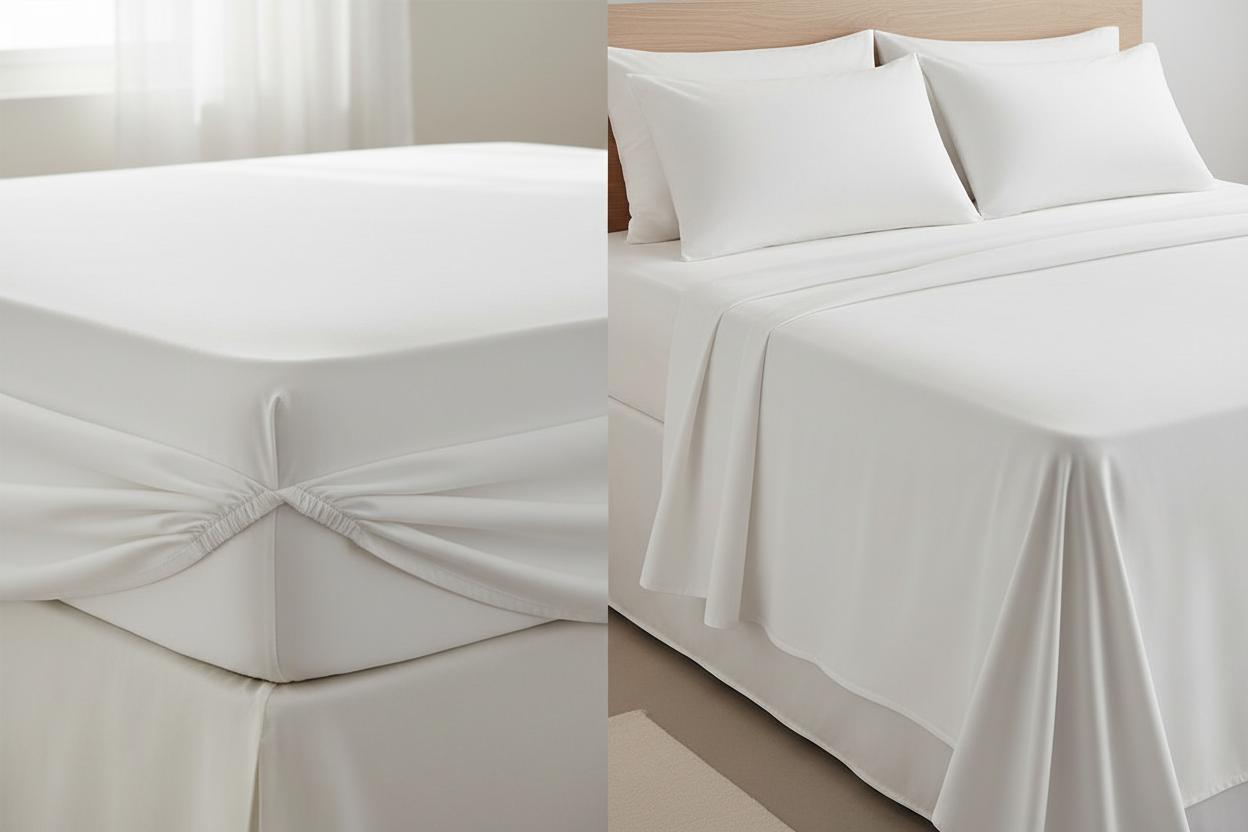
Quick Answer: Fitted bedsheets have elasticated corners that grip the mattress — they stay tight, look neat, and don't slip during sleep. Flat bedsheets are simple rectangles you tuck under the mattress — versatile, easier to wash, and forgiving on size. Most Indian homes do best with both: a fitted sheet on the mattress for a neat base, and a flat sheet on top to switch out for laundry. If you can only choose one, fitted is better for daily use and modern beds.
The fitted-vs-flat debate is older than most marriages. Both sides are passionate, and both are partly right. The real answer depends on your mattress depth, how often you change sheets, and how neatly you want your bed to look without effort. This guide breaks down both — with sizing rules and Indian-context recommendations.
Whether you're shopping the Premium Fitted collection or the Premium Flat collection, here's what to know first.
What is a fitted bedsheet?
A fitted bedsheet is shaped like a shallow box. It has elastic sewn into all four corners (sometimes all the way around) that grips the mattress, locking the sheet in place. You pull it on like a swim cap — corners over the corners of the mattress, and the sheet snaps tight.
What is a flat bedsheet?
A flat bedsheet is a simple rectangle. You spread it across the mattress and tuck the excess under all four sides. No elastic, no shaping. It's the older format — what most Indian families grew up with.
Fitted vs flat: head-to-head
Neatness
Fitted wins. Once installed, the sheet stays tight and the bed looks made without effort. Flat sheets pull loose during sleep, especially with active sleepers — you wake up with the sheet bunched in the middle.
Mattress compatibility
Fitted matters here. Modern Indian mattresses are 8–12 inches deep (memory foam, hybrid). Flat sheets can struggle to tuck under deep mattresses; fitted sheets are sized to fit specific depths.
Ease of installation
Flat wins. Spread, tuck, done. Fitted takes a minute and a bit of strength on heavy mattresses — those corners can be tight.
Washing and drying
Flat wins slightly. Flat sheets fold and dry faster on the line. Fitted sheets have elastic that needs gentle washing to last.
Price
Both similar. Fitted is marginally more expensive due to the elastic and sewing.
Versatility
Flat wins. A flat sheet can serve as a top sheet (between you and the duvet), a beach picnic blanket, or a temporary cot covering. Fitted is single-purpose.
The honest Indian recommendation: use both
The cleanest setup, used by hotels and well-organised Indian homes:
- Fitted sheet on the mattress. Stays in place, never bunches.
- Flat sheet on top. Between you and the duvet/blanket. Easier to wash separately.
- Duvet or blanket on top of the flat sheet.
This way, the fitted sheet rarely needs changing (it's protected by the flat sheet), and the flat sheet rotates through laundry without disturbing the base.
When to pick fitted only
- Deep memory-foam mattresses (10+ inches) where flat sheets won't tuck cleanly.
- Active sleepers who toss and turn — fitted stays put.
- Kids' beds — fitted sheets survive bedtime chaos better.
- Modern bedroom design where you skip the top sheet entirely.
Browse the Premium Fitted collection (179 designs) or the size-specific options: King fitted, Double fitted, Single fitted.
When to pick flat only
- Shallow mattresses (under 8 inches).
- Travel — flat sheets pack smaller.
- Multi-purpose use (covering, picnic, throw).
- Budget constraints — flat sheets often come with pillow covers as a set.
Sizing fitted sheets correctly
Three numbers matter:
- Length — mattress length (usually 75–78 inches).
- Width — mattress width (36, 48, 54, 60, or 72 inches by size).
- Depth (pocket size) — mattress depth + 2 inches for elastic grip.
Indian standard fitted sheets have 8–10 inch pockets. If your mattress is 12+ inches deep (common in modern memory foam), look for the Premium Fitted range with deep-pocket options.
Common mistakes
- Buying fitted without measuring depth. Standard 8-inch pockets slip off 12-inch mattresses.
- Using flat sheets on deep mattresses. Tucking is inadequate; sheets slip out by morning.
- Tumble-drying fitted on high heat. Damages the elastic. Air-dry or low-tumble.
- Folding fitted poorly. Use the proper fold method — first time takes a YouTube tutorial.
Frequently Asked Questions (FAQs)
Q. Do I need both a fitted and flat sheet?
A. Not strictly. But layering both is the cleanest setup — fitted stays on the mattress, flat goes between you and the blanket and washes separately.
Q. Are fitted sheets better than flat sheets for kids?
A. Yes — fitted stays in place through bedtime chaos. Less re-making the bed every morning.
Q. Why do fitted sheets cost slightly more?
A. Elastic plus extra stitching at the corners. The premium is small (₹50–150 typically).
Q. Can a fitted sheet be too tight on the mattress?
A. Yes — if the mattress is deeper than the pocket size. Always measure mattress depth before ordering.
Q. Do flat sheets stay in place on Indian mattresses?
A. On shallow mattresses (under 8 inches), yes. On deep modern mattresses, they slip — fitted is the better answer.
Final Word. Fitted on the mattress, flat on top, blanket above — the cleanest setup. Browse the fitted and flat collections to start.
More from the Bedsheet Buying Series
- → Thread Count Explained
- → Percale vs Sateen Bedsheets
- → King vs Queen vs Double Sizing
- → Cotton vs Microfiber Bedsheets
- → Bedsheet GSM Explained
- → Best Bedsheets for Hot Sleepers
- → Combed Cotton vs Regular Cotton
- → Fitted vs Flat Bedsheets (you are here)
- → How to Wash Cotton Bedsheets
- → Why Pre-Shrunk Cotton Matters
- → 300 TC vs 200 TC: Real Differences
- → Satin vs Cotton Bedsheets
