


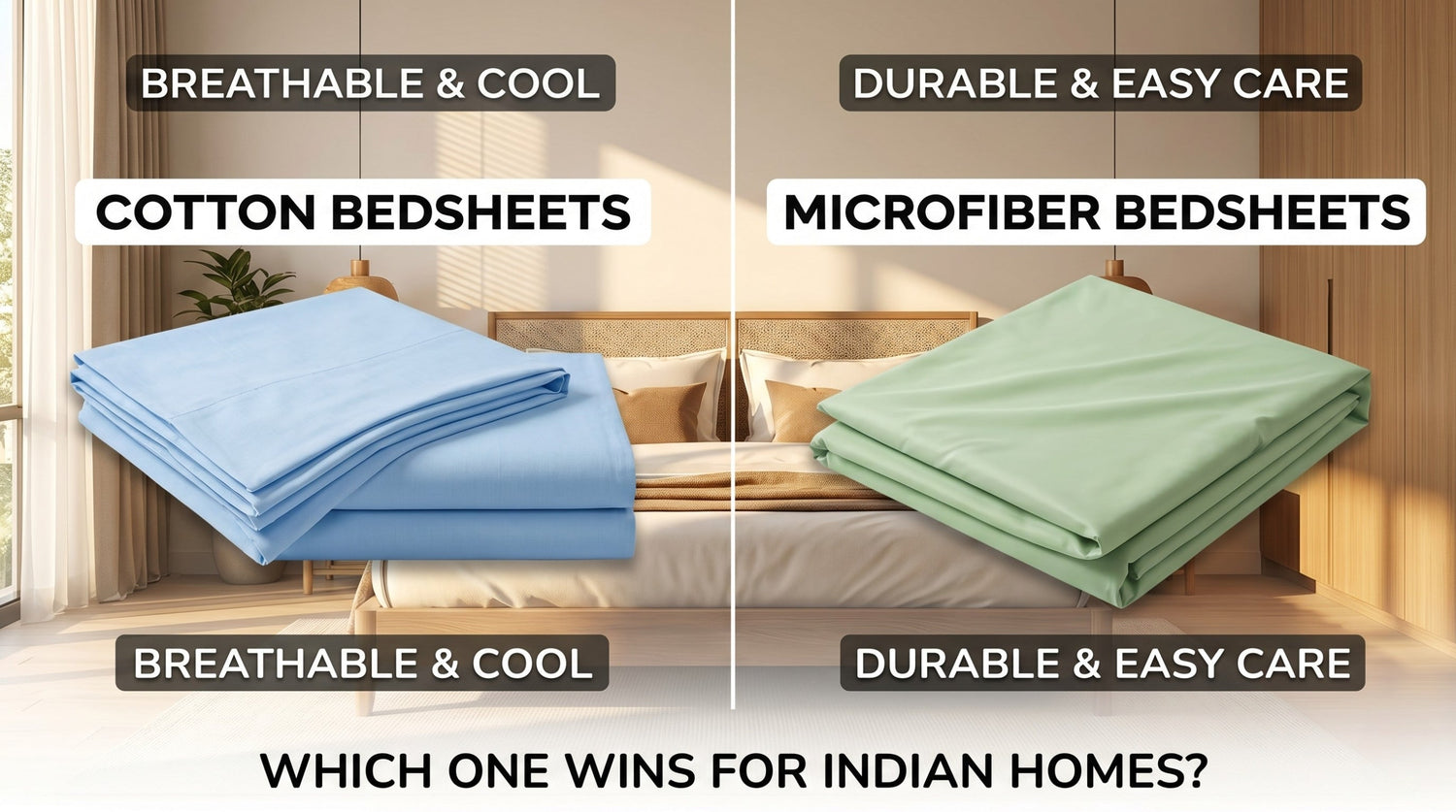
Quick Answer: Cotton bedsheets win for Indian homes in almost every category that matters — breathability, skin safety, durability, and long-term value. Microfiber wins on initial price (cheaper by 30–40%), wrinkle resistance, and quick-drying. For year-round Indian use, especially in hot humid climates, 100% cotton is the clear choice. Microfiber works only for tight budgets, guest rooms, or short-term use. The price difference disappears over 3 years because microfiber wears out faster and feels worse in summer.
Walk into any bedding aisle in India and you'll see two camps: cotton (slightly pricier, classic, widely loved) and microfiber (cheaper, glossy, marketed aggressively as 'smooth'). The packaging makes the choice feel close — but in real Indian conditions, the gap is wider than it looks. This guide breaks down both fabrics across every metric that matters, so you stop guessing and start choosing.
Whether you're upgrading your master bedroom or stocking a new home, the Haus & Kinder bedsheet collection sticks to 100% cotton — and this is exactly why.
What is cotton bedding?
Cotton bedsheets are made from natural cotton fibres — usually long-staple combed cotton in premium ranges. The fibre is breathable, soft, hypoallergenic, and improves with washing. Indian cotton is among the best in the world; brands using long-staple combed varieties (like Suvin, Pima, or Egyptian) deliver hand feel comparable to imports at lower price points.
What is microfiber bedding?
Microfiber is a synthetic — usually finely woven polyester (sometimes a polyester-nylon blend) with fibre thickness under 1 denier. It's smooth, glossy, and wrinkle-resistant. The fibres are essentially plastic, which is why microfiber feels different from cotton even when both are labelled 'soft'.
Cotton vs microfiber: head-to-head comparison
Breathability
Cotton wins by a wide margin. Cotton fibres allow air to flow freely between threads, wicking moisture away from the body. In Indian summers, this is the difference between waking up dry and waking up sweat-stuck. Microfiber traps heat against the skin — fine in winter or AC bedrooms, uncomfortable in non-AC summer use.
Skin safety
Cotton is hypoallergenic, breathable, and gentle on sensitive skin — including babies and people with eczema or skin conditions. Microfiber, being synthetic, can trigger reactions in sensitive sleepers, especially when treated with fabric finishes. Most paediatricians recommend pure cotton for cribs and kids' beds for exactly this reason.
Durability
Cotton lasts 3–5 years with normal use; microfiber lasts 1–2 years before pilling, fading, or thinning out. Microfiber's smooth surface scratches and shows wear faster. Cotton actually softens with each wash.
Feel and softness
Microfiber feels smooth out of the package. Cotton starts crisper, then softens dramatically after 5–10 washes. By month 2 of use, premium cotton feels softer than microfiber — and stays that way. The 'wow' factor of microfiber wears off; the comfort of cotton compounds.
Wrinkling
Microfiber wins. It resists wrinkles, dries fast, and rarely needs ironing. Cotton wrinkles more visibly but irons cleanly with steam. If you're someone who hates ironing, microfiber is more convenient — but most people find cotton wrinkles acceptable after one quick steam pass.
Heat retention
Microfiber traps heat. Cotton releases it. In Indian summers, this is decisive. Even in AC bedrooms, microfiber holds body heat against the skin and increases the cooling load. Cotton allows the AC to do its job efficiently.
Care and washing
Both are machine-washable. Cotton tolerates higher temperatures and harsher detergents better — useful for stubborn stains. Microfiber must be washed in cool water and never bleached (the fibres degrade). Cotton can be tumble-dried if pre-shrunk; microfiber should air-dry to preserve the smoothness.
Price
Microfiber wins on initial price — typically 30–40% cheaper than equivalent cotton. But the price-per-year of use is closer than it looks. A ₹999 microfiber sheet that lasts 18 months costs ₹666/year. A ₹1,599 cotton sheet that lasts 4 years costs ₹400/year. Cotton is cheaper in the long run despite the higher sticker.
Environmental impact
Cotton is biodegradable. Microfiber sheds microplastics into water systems with every wash — small fragments that don't break down. For environmentally conscious buyers, cotton is the clear choice.
Where microfiber genuinely makes sense
Microfiber isn't all bad. Real-world cases where it works:
- Guest rooms with rare use. Wrinkle-resistance matters more than breathability when no one's sleeping on it.
- Tight budgets where bedding is functional, not luxe. Hostel rooms, rental units, short-term needs.
- Cold-climate winter use. Heat retention is a feature, not a bug, in Shimla or Manali in December.
- Travel sheets / sleeping bag liners. Lightweight, fast-drying, packable.
Where cotton is non-negotiable
- Hot, humid climates. Mumbai, Chennai, Bengaluru — cotton or you'll sweat through.
- AC bedrooms used year-round. Lower cooling cost, more comfort.
- Babies and children. Skin safety, breathability, no microplastics.
- People with allergies or eczema. Cotton is the standard recommendation.
- Daily-use master bedrooms. Year-round comfort and durability.
For premium cotton options, browse the 300 TC premium cotton range — silky on first feel, durable for years.
How to spot fake 'cotton' bedsheets
Microfiber is sometimes mislabelled or marketed under terms like 'cotton feel', 'silk cotton', or 'glace cotton' — none of which mean 100% cotton. Red flags:
- Label says 'cotton rich' or 'cotton blend' — usually 50% polyester or more.
- Glossy, slippery feel out of the package.
- Unusually low price for the size (under ₹600 for queen).
- No GSM, thread count, or fibre type listed.
- Wrinkle-free claim with no ironing needed.
Real cotton wrinkles. Real cotton lists thread count, GSM, and fibre type. If the label is vague, the fabric is too.
What about cotton-microfiber blends?
Blends (60% cotton + 40% polyester, etc.) try to deliver cotton's breathability with microfiber's wrinkle resistance. In practice, they get the worst of both: less breathable than 100% cotton, less smooth than 100% microfiber, and they pill faster than either. Skip blends for primary-use bedding.
Frequently Asked Questions (FAQs)
Q. Is microfiber better than cotton for AC bedrooms?
A. No. Even in AC bedrooms, cotton breathes better and feels more comfortable for long sleep. Microfiber traps heat against the skin, which AC has to work harder to remove.
Q. Why does my microfiber sheet pill so fast?
A. Microfiber's fine synthetic fibres wear at the surface within 6–12 months of regular washing. Cheap microfiber pills faster than premium. Switching to combed cotton at the same price tier solves it.
Q. Are microfiber bedsheets safe for babies?
A. Most paediatricians recommend 100% cotton for cribs because of breathability and lower allergy risk. Microfiber can trap heat, which infants regulate poorly, and may shed microplastics during washing.
Q. Do microfiber bedsheets cause skin problems?
A. They can — especially in hot, sweaty conditions where the trapped moisture creates fungal or bacterial growth on the skin. Cotton's breathability prevents this.
Q. Why are microfiber bedsheets cheaper than cotton?
A. Cotton is a natural fibre with seasonal supply and labour-intensive processing (ginning, combing, weaving). Microfiber is synthesised from petrochemicals at industrial scale — cheaper to make but lower in quality and lifespan.
Final Word. Cotton is worth the extra ₹500–₹800 over microfiber. Browse the Haus & Kinder bedsheet collection — 100% cotton, AZO-free, pre-shrunk, sized for Indian beds.
More from the Bedsheet Buying Series
- → Thread Count Explained: What Really Matters
- → Percale vs Sateen Bedsheets: Which One Should You Choose?
- → Top 7 Things to Consider Before Buying Bedsheets Online in India
- → Cotton vs Microfiber Bedsheets: Which One Wins for Indian Homes? (you are here)
