


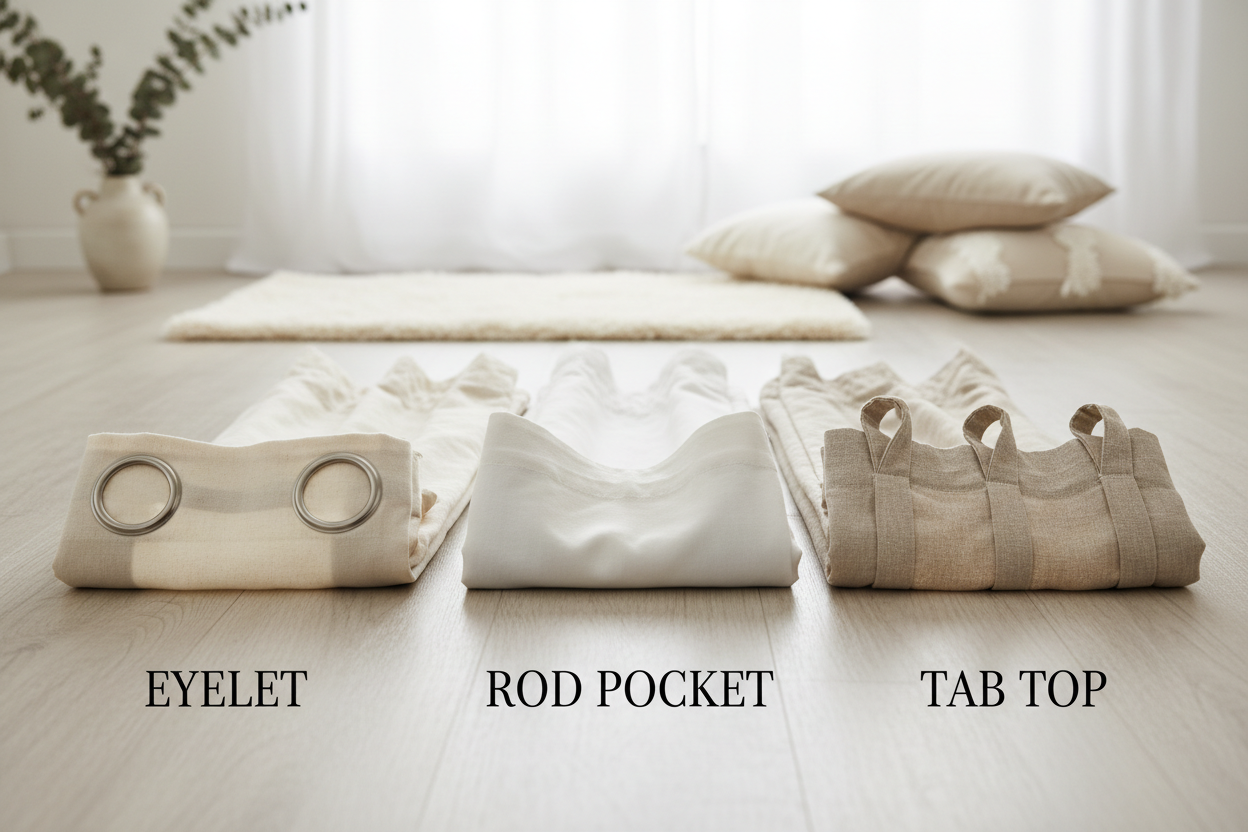
Quick Answer: Eyelet curtains have metal rings at the top — modern, easy-slide, the most popular Indian choice. Rod pocket curtains have a sewn tunnel for the rod — clean, gathered, slower to draw. Tab top curtains have fabric loops — casual, decorative, suited to lighter fabrics. Pick eyelet for daily use, rod pocket for a soft formal look, and tab top for relaxed informal rooms.
The "header" is the top edge of a curtain — the part that attaches to the rod. Most Indian buyers focus on fabric and colour first, then realise the header style decides everything else: which rod you need, how the curtain looks gathered, and how easily it slides. Wrong header = a curtain that frustrates you every morning.
This guide compares the three most common headers — eyelet, rod pocket, and tab top — across function, style, and price. Whether you're shopping curtains for the first time or replacing existing ones, this is the spec to lock down first.
What is eyelet (grommet)?
Eyelet curtains have metal rings (typically 8–10 per panel) inset into the top edge. The rod slides through the rings. The result is uniform, sculpted ripples of fabric — modern, structured, and easy to slide.
- Look: modern, clean, sculpted folds.
- Rod: needs a rod that fits through 1–1.5 inch rings.
- Slide ease: excellent — smoothest of all headers.
- Best for: living rooms, bedrooms, daily-use windows.
What is rod pocket?
Rod pocket curtains have a sewn-in fabric tunnel at the top. The rod slides through the tunnel, gathering the fabric naturally into soft folds. They look romantic and relaxed but slide slowly — fabric drags on the rod every time you open them.
- Look: soft, gathered, traditional.
- Rod: slim rod (under 1 inch).
- Slide ease: low — fabric drags.
- Best for: formal rooms, layered sheers, curtains that stay mostly closed.
What is tab top?
Tab top curtains have fabric loops (usually 6–10 per panel) sewn into the top edge. The rod slides through the loops, with the rod visible between them. The look is casual and architectural — suits industrial, rustic, and kids' room interiors.
- Look: casual, relaxed, slightly bohemian.
- Rod: thin-to-medium (under 1.5 inches).
- Slide ease: medium.
- Best for: kids' rooms, casual spaces, kitchen cafes.
Header comparison — head to head
Visual style
Eyelet looks modern and clean — uniform folds, no visible rod. Rod pocket looks softer and traditional — gathered ruffles. Tab top looks intentionally casual — visible rod between loops.
Slide ease
Eyelet wins by a wide margin. Rod pocket is the worst (fabric drag). Tab top is in between. If you draw curtains daily, eyelet saves the most friction.
Rod compatibility
Eyelet needs a rod that fits through the rings — 1–1.5 inch diameter. Rod pocket needs a thin rod. Tab top works with most rods under 1.5 inches. Heavy blackout curtains in eyelet style need sturdy brackets for the fabric weight.
Fullness
Eyelet gives uniform fullness automatically. Rod pocket creates dense gathering — needs more width. Tab top has slightly less fullness because loops space out fabric.
Which header for which room?
- Living room (daily-use): Eyelet — smooth slide.
- Bedroom blackout: Eyelet with thicker rod.
- Kids' room: Tab top in printed cotton.
- Formal dining: Rod pocket with sheer voile.
- Layered look: Rod pocket sheer behind, eyelet blackout in front.
- Kitchen cafe: Tab top, sill-length.
Five common header mistakes
- Eyelet on a too-thick rod. Measure the rod diameter first.
- Rod pocket for daily-use curtains. Fabric drag will frustrate you within a week.
- Tab top with very heavy fabric. Loops can tear under blackout weight.
- Forgetting fullness. Rod pocket needs more fabric width than eyelet.
- Mixing headers on the same window. Looks inconsistent.
Frequently Asked Questions (FAQs)
Q. What is the most popular curtain header in India?
A. Eyelet (grommet). About 70% of Indian curtain purchases are eyelet — easy slide, clean look.
Q. Can I use eyelet curtains with any rod?
A. No — the rod must fit through the rings. Inner ring diameter is usually 1–1.5 inches.
Q. Are rod pocket curtains outdated?
A. Not outdated, but slow to slide. Best for formal rooms and layered setups.
Q. Tab top vs eyelet for kids' rooms?
A. Tab top for casual cotton prints; eyelet if you need blackout for naps.
Q. Do different headers need different rods?
A. Yes. Match before buying — eyelet (rod through rings), rod pocket (slim rod), tab top (most thin-medium rods).
Final Word. Eyelet is the default for a reason — most forgiving header in India. Browse the full curtain collection for eyelet, rod pocket, and tab top across fabrics.
More from the Curtain Buying Series
- → How to Choose Perfect Curtains for Every Room
- → Blackout vs Sheer Curtains
- → How to Measure Curtains Correctly
- → Curtain Care Guide
- → Best Curtain Fabrics for Indian Summers
- → Eyelet vs Rod Pocket vs Tab Top (you are here)
- → Cotton vs Polyester Curtains
- → Best Curtain Colors for Indian Living Rooms
- → How to Layer Sheer + Blackout
- → Jacquard Curtains: The Hidden Gem
