


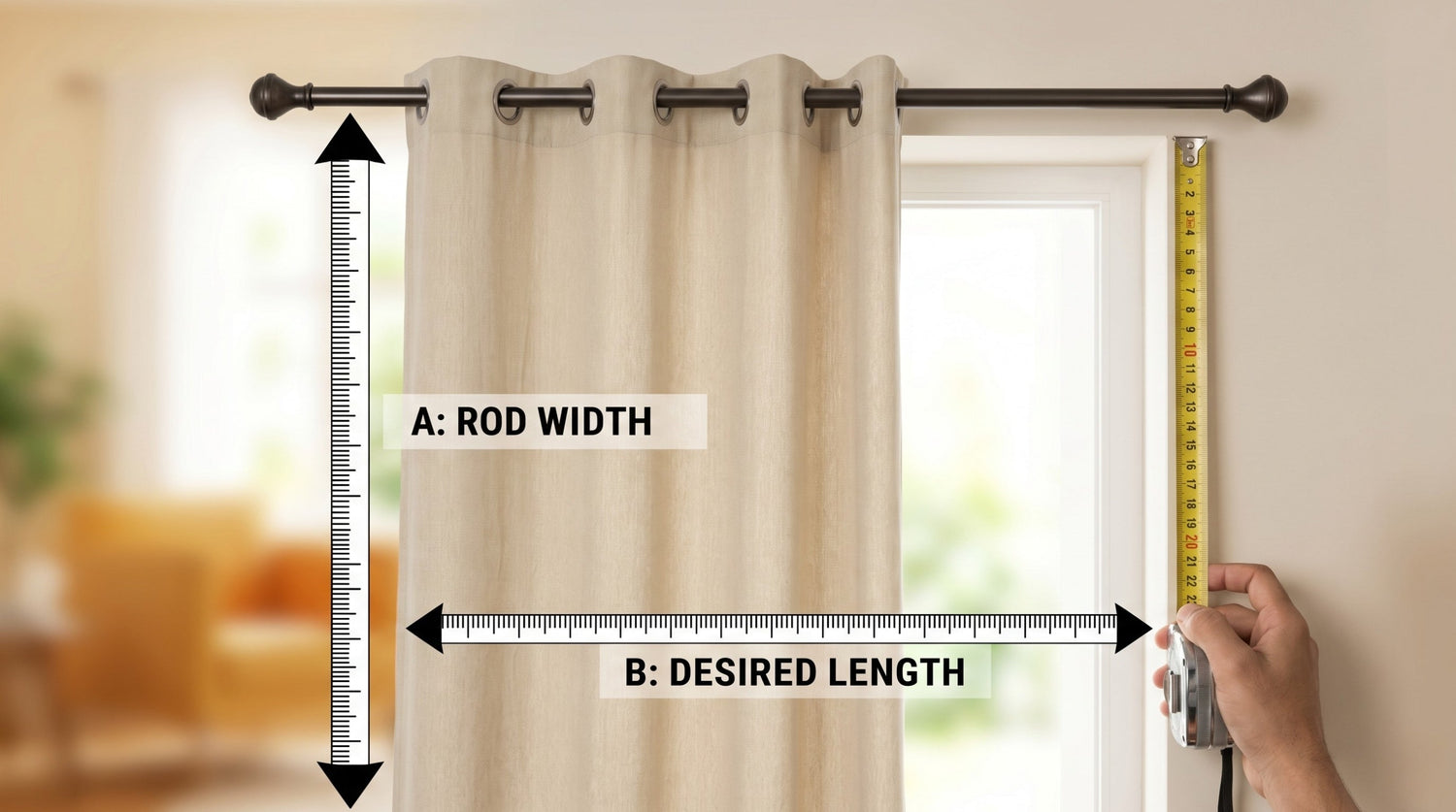
Quick Answer: To measure curtains correctly in Indian homes: (1) install the rod 4–6 inches above the window frame and 4–6 inches wider than it on each side, (2) measure curtain length from the rod down to your preferred end-point (floor for living and bedrooms, sill for kitchens), (3) order a width that's 1.5×–2× your rod length for proper fullness. Standard Indian curtain lengths are 5 ft, 7 ft, and 9 ft. Common mistakes — measuring the window instead of the rod, or buying a curtain the same width as the rod — make every other curtain choice look cheap.
Ordering curtains online is half the battle. The other half is measuring properly — and this is where most Indian buyers go wrong. A perfectly chosen blackout curtain in the wrong length looks awkward. A premium fabric ordered without enough fullness hangs flat and skinny. Get the measurements right, and even a budget curtain looks designed.
This guide walks through every step of measuring curtains for Indian windows and doors, with rules of thumb that work for apartments, villas, and renovated homes. Whether you're shopping the Haus & Kinder curtain collection or upgrading existing window dressing, run through these steps before you click order.
Tools you'll need
You don't need anything fancy — just a steel measuring tape (cloth tapes stretch), a ladder if your windows are tall, and a notepad. Take a photo of your window for reference. Measure each window individually even if they look identical — Indian construction tolerances are generous, and you'll find 1–2 inch differences between supposedly matching windows.
Step 1 — Install (or plan) the curtain rod
The rod position changes everything. Before you measure for fabric, decide where the rod will sit. Two non-negotiable rules from interior designers:
- Hang high. Install the rod 4–6 inches above the window frame — closer to the ceiling, not the window. This makes the window look taller and the room look bigger.
- Hang wide. Extend the rod 4–6 inches beyond the window frame on each side. This lets the open curtain stack to the side without blocking light.
If you're floor-to-ceiling glass or a balcony door, install the rod just below the ceiling and use a 9 ft curtain. The drama is worth it.
Step 2 — Measure the curtain length
Length is measured from the top of the rod (or the bottom of the eyelet, depending on header) down to where you want the curtain to end. There are three common end-points:
Floor-touching (1 cm above floor)
Cleanest, most common look for living rooms and bedrooms. Measure from the rod to 1 cm above the floor. Use this length for any room where the curtain stays mostly closed or partially closed.
Puddled (1–4 inches on the floor)
Romantic, formal look. Measure rod to floor, then add 1–4 inches. Best for master bedrooms, formal living rooms, or velvet curtains. Avoid in kids' rooms (trip hazard) and high-traffic doors.
Sill-length
End at the bottom of the window sill or 2 inches below it. Use this for kitchens, bathrooms, and small windows where floor-length isn't practical.
Step 3 — Standard Indian curtain lengths
Most Indian brands sell pre-cut curtains in three lengths. If your custom measurement falls between two standard sizes, round up — never down.
- 5 ft (60 inches): small windows, kitchens, half-height bathrooms.
- 7 ft (84 inches): standard doors, balcony entries, medium windows.
- 9 ft (108 inches): long doors, floor-to-ceiling installations, modern apartments with high ceilings.
The Haus & Kinder curtain collection stocks all three lengths in cotton, polyester, blackout, and sheer fabrics — so once you know your size, the rest is style choice.
Step 4 — Measure the curtain width
Width is where most online buyers get burned. The single biggest mistake: ordering a curtain the same width as the rod. That gives you a flat, skinny, hospital-curtain look. The fix is simple — order extra fullness.
Fullness multipliers
- 1.5× rod width: bare minimum for a presentable look. Use for budget projects only.
- 2× rod width: the sweet spot. Used by most interior designers for a clean, full drape.
- 2.5–3× rod width: luxurious, heavy fullness. Use for sheer panels and formal rooms.
Example: if your rod is 5 ft wide, order curtains totalling 10 ft of fabric width. That usually means two panels of 5 ft each, drawn from both sides.
Step 5 — Decide on header style and rod compatibility
The "header" is the top edge of the curtain — and it determines what kind of rod you need. Match the two before ordering:
- Eyelet (grommet) — most popular in India. Needs a thin rod that fits through the metal rings (typically 1–1.5 inches diameter).
- Rod pocket — needs a slim rod that slides through the fabric tunnel.
- Tab top — fabric loops; needs a regular rod under 1.5 inches thick.
- Pinch pleat — formal look; uses hooks attached to a track or fancy rod.
For heavy fabrics like velvet or full blackout curtains, use a thicker rod (1.5+ inches) with sturdy brackets to handle the weight without sagging.
Step 6 — Double-check before ordering
Two final sanity checks save you from returns:
- Re-measure both height and width — twice. Indian construction varies; trust your tape, not the architect's drawing.
- Check the product page's listed dimensions against your numbers. Note that curtain "size" usually means per-panel — so a "5 ft x 7 ft, set of 2" actually gives you 10 ft of total width.
Quick measurement checklist (save this)
- ☐ Rod installed 4–6 inches above window frame
- ☐ Rod extends 4–6 inches beyond frame on each side
- ☐ Length measured from rod to desired end-point
- ☐ Width = 1.5×–2× rod length for fullness
- ☐ Header style matches your rod type
- ☐ Each window measured individually
- ☐ Custom size rounded up, never down
Frequently Asked Questions (FAQs)
Q. Should I measure the window or the rod for curtain length?
A. The rod. The curtain hangs from the rod, not from the window frame. If the rod is 4–6 inches above the frame (recommended), measuring from the window will leave you 4–6 inches short.
Q. What's the most common Indian curtain length?
A. 7 ft. It fits standard doors and most balcony entries. 9 ft is rapidly growing because new apartments have higher ceilings.
Q. How wide should my curtain be compared to the window?
A. Plan the rod to be 8–12 inches wider than the window total (4–6 inches per side), and the curtain fabric to be 1.5×–2× the rod length. So a 4 ft window typically needs a 5 ft rod and 8–10 ft of curtain fabric.
Q. Can I use the same curtain length across all rooms?
A. No — kitchens and bathrooms need shorter curtains (sill or cafe length) for hygiene and practicality. Living rooms and bedrooms need floor-length for a polished look.
Q. What if my window measurement is between two standard sizes?
A. Always round up. A curtain that's slightly too long can be hemmed or pooled; a curtain that's too short cannot be fixed.
Final Word. Once your measurements are right, the fun begins. Browse the full Haus & Kinder curtain collection for blackout, sheer, cotton, and polyester options sized for Indian windows.
More from the Curtain Buying Series
- → How to Choose the Perfect Curtains for Every Room
- → Blackout vs Sheer Curtains: Which to Choose?
- → 7 Things to Consider Before Buying Curtains Online in India
- → How Curtains Improve Privacy, Lighting, and Aesthetics
- → How to Measure Curtains Correctly: A Step-by-Step Guide for Indian Homes (you are here)
