


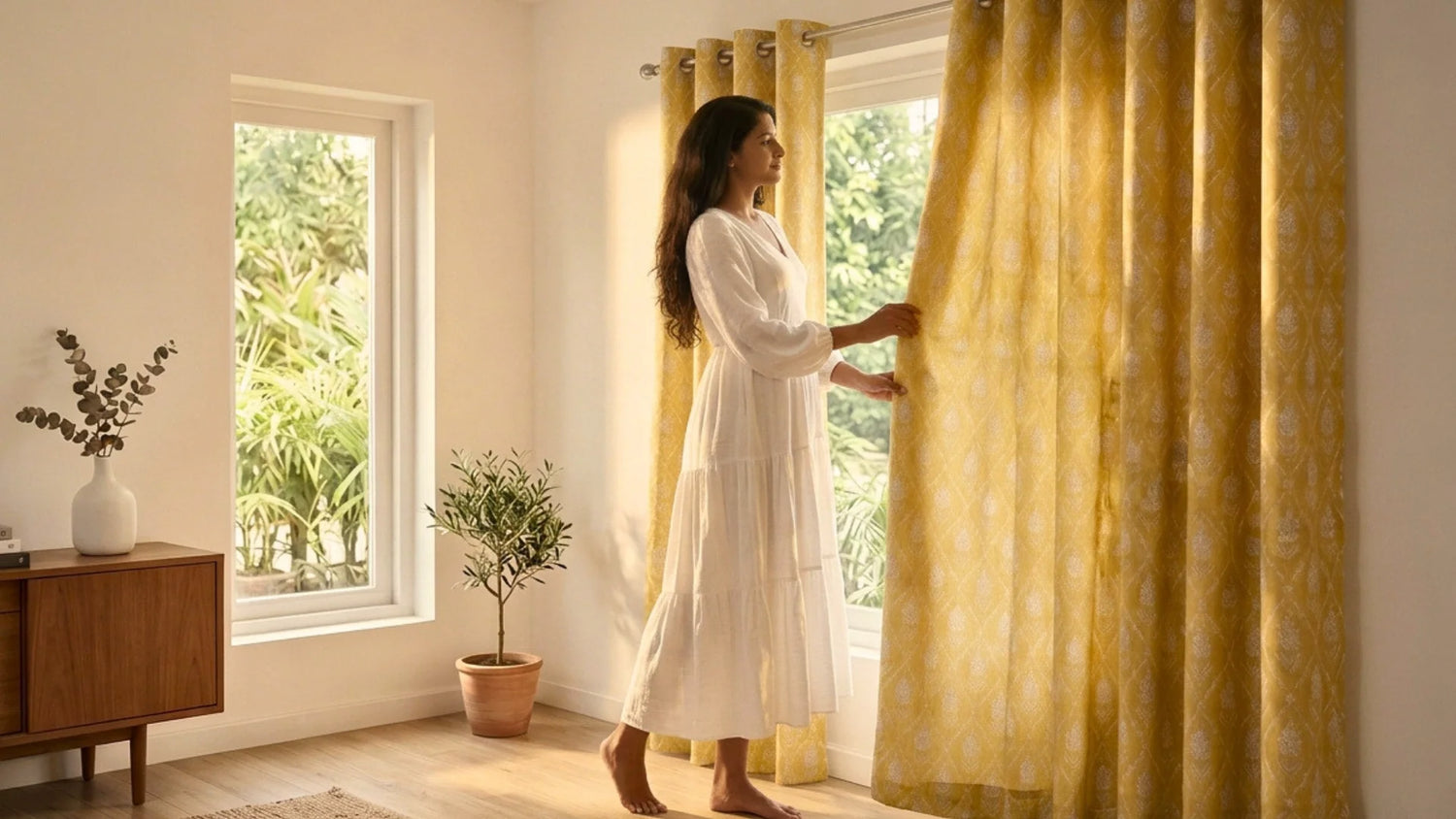
Quick Answer: Jacquard curtains have patterns woven directly into the fabric — not printed on top. The result is a textured, three-dimensional surface that looks richer than printed curtains and lasts 1–2 years longer because the pattern can't peel or fade. They sit between cotton and velvet in weight, suit living rooms and master bedrooms, and pair beautifully with both modern and traditional Indian interiors.
Most Indian curtain buyers see "jacquard" on a product page and skip past it — assuming it's a premium variant of polyester or cotton. The reality is more interesting. Jacquard isn't a fabric; it's a weaving technique. The result is one of the most underrated curtain types available in India today: rich-looking, durable, and surprisingly versatile.
This guide explains what jacquard is, where it shines, and how to use it in Indian living rooms and bedrooms. Whether you're new to jacquard curtains or considering them for a specific room, here's everything that matters.
What is jacquard?
Jacquard is a centuries-old weaving technique that produces complex patterns directly in the fabric. Unlike printed curtains where the pattern is applied to the surface, jacquard patterns are part of the weave itself. This means the design appears on both sides (slightly different shade), can't peel off, and creates a subtle three-dimensional texture you can feel by hand.
Jacquard fabrics can be made from cotton, polyester, or blends. The technique is what matters — not just the fibre.
Why jacquard curtains look more expensive
Three reasons:
- Textured surface: light hits the curtain at varying angles, creating depth.
- Subtle pattern: woven motifs are gentler than printed ones — they read "classic" not "trendy".
- Heavier drape: jacquard is denser than basic cotton, so it falls in soft, sculpted folds.
The combined effect is a curtain that elevates a room without making the curtain itself the loud focal point. That's the hallmark of premium interiors.
Jacquard vs printed curtains
Pattern longevity
Jacquard wins. Woven patterns don't fade or peel. Printed patterns can lose vibrancy in 2–3 years of direct sun, especially in west-facing windows.
Texture
Jacquard wins. The fabric has tactile depth — you can feel the pattern. Printed curtains feel flat by comparison.
Two-sidedness
Jacquard wins. Pattern shows on both sides (lighter shade on reverse). Printed curtains have a plain reverse.
Pattern variety
Printed wins. Almost any design can be printed; jacquard is limited to woven motifs (typically florals, damasks, geometrics, and traditional patterns).
Price
Jacquard is 20–40% more expensive than equivalent printed curtains. The cost difference reflects the weaving complexity and durability.
Jacquard vs solid curtains
- Solids are simpler and cheaper, but flatter visually.
- Jacquard adds texture without adding "loudness".
- Solids work better in already-busy rooms (lots of art, patterns, prints). Jacquard works better in calm rooms that need lift.
Best rooms for jacquard curtains
Master bedroom
Jacquard's texture and richness suit master bedrooms. Pair a tonal jacquard (curtain shade close to wall) with neutral bedding for a hotel-suite feel.
Living room
The original home for jacquard. Paired with a solid sofa, jacquard curtains become the textural focal point of the room without dominating it.
Dining room
Formal dining settings love jacquard. The traditional damask motifs work beautifully in this context.
Less ideal rooms
- Kitchen: too heavy, harder to wash than basic cotton.
- Kids' room: the formal feel doesn't suit playful spaces.
- Bathroom: humidity damages the textured surface over time.
Jacquard sheer — a special variant
Lightweight jacquard sheers blend the texture of jacquard with the airiness of sheer voile. They suit large living-room windows where you want pattern and softness simultaneously. Browse the jacquard sheer collection for designs sized for Indian doors and windows.
How to style jacquard curtains
- Pair with solid walls — let the jacquard be the texture.
- Match curtain tone to the wall (tonal) or to the sofa (anchor) — both work.
- Avoid pairing jacquard with another patterned element nearby (printed rug, busy artwork).
- Use floor-length panels — short jacquard looks awkward.
- Eyelet header works best — clean folds show off the woven pattern.
Care for jacquard curtains
- Vacuum-dust every 2–4 weeks; texture traps more dust than smooth fabrics.
- Cotton jacquards: gentle machine wash, cold water.
- Heavy or polyester jacquards: professional dry-cleaning every 6 months.
- Iron on the reverse side to protect the woven pattern.
- Avoid bleach — strips the contrast between pattern and ground.
Frequently Asked Questions (FAQs)
Q. Is jacquard better than printed curtains?
A. For longevity and premium feel — yes. For variety of designs — printed has more options.
Q. Can you wash jacquard curtains?
A. Cotton jacquards yes (gentle cycle). Heavier polyester jacquards prefer dry-cleaning.
Q. Is jacquard suitable for summer use?
A. Medium-weight jacquards work in summer; heavy jacquards trap heat. Check the GSM before buying.
Q. Do jacquard curtains block light?
A. Partially — they're not blackout, but the dense weave does reduce light meaningfully. For full blackout, layer with a blackout panel.
Q. Are jacquard curtains worth the price?
A. In rooms where you want richness without loudness — yes. The texture and longevity justify the 20–40% premium.
Final Word. Jacquard is the curtain category most Indian homes ignore — and shouldn't. Browse the jacquard collection and the jacquard sheer range for living-room-ready designs.
More from the Curtain Buying Series
- → How to Choose Perfect Curtains for Every Room
- → Blackout vs Sheer Curtains
- → How to Measure Curtains Correctly
- → Curtain Care Guide
- → Best Curtain Fabrics for Indian Summers
- → Eyelet vs Rod Pocket vs Tab Top
- → Cotton vs Polyester Curtains
- → Best Curtain Colors for Indian Living Rooms
- → How to Layer Sheer + Blackout
- → Jacquard Curtains: The Hidden Gem (you are here)
