


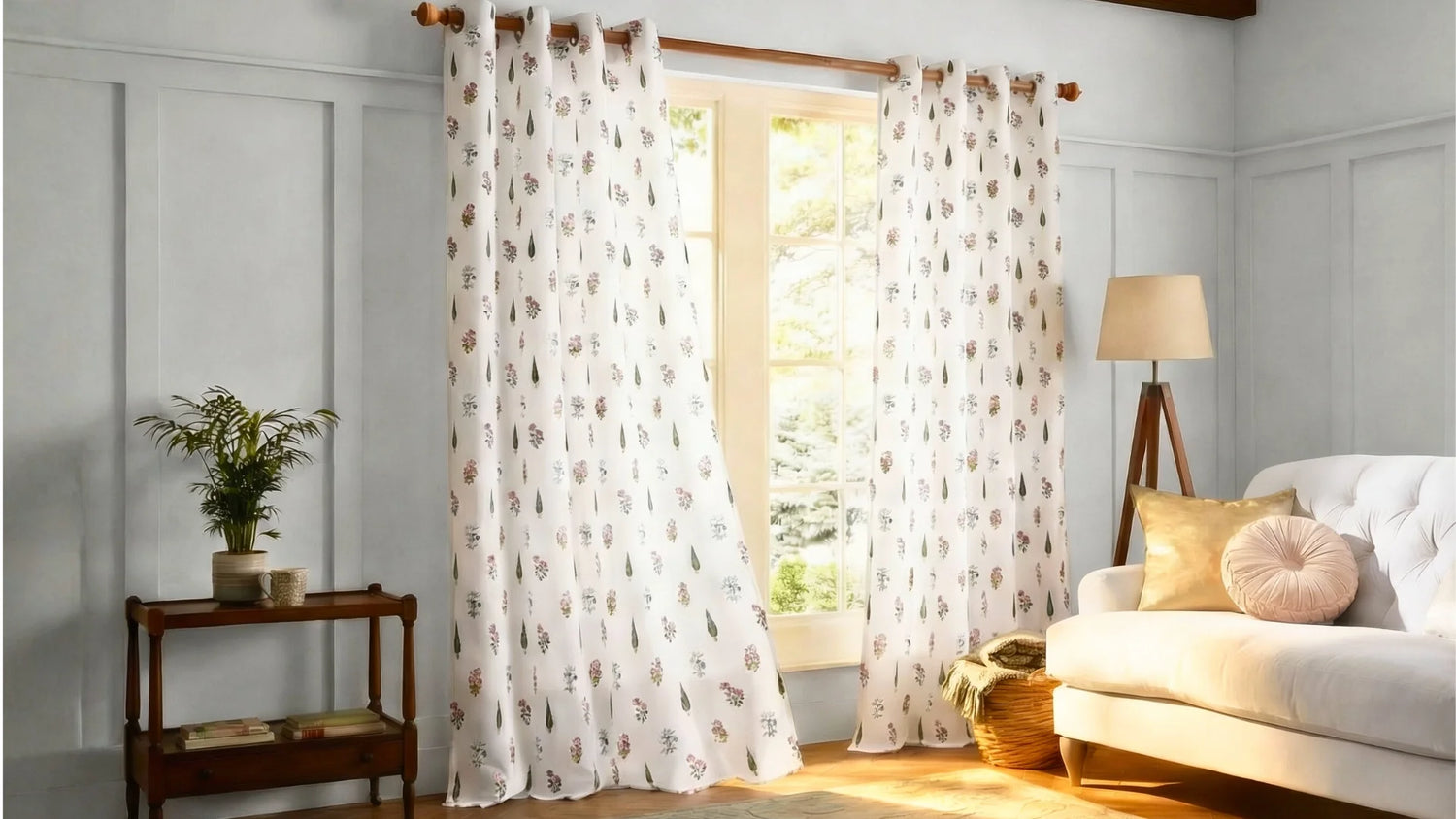
Quick Answer: The safest curtain colours for Indian living rooms are warm neutrals (ivory, beige, taupe), muted greens (sage, olive), and dusty blues (powder, slate). These tones pair with almost every Indian wall colour and sofa, age gracefully, and don't fight with the natural light. Avoid jet black and pure white in living rooms — both show dust fast in Indian conditions.
Curtains are the largest fabric element in a living room. Their colour either anchors the space beautifully or creates visual chaos. The wrong shade can make a room feel smaller, colder, or busier than intended. The right shade ties everything together effortlessly.
This guide gives you a pairing system that works for any Indian living room. Whether you're shopping curtains for a 2BHK or a villa, these rules apply.
The three colour pairing strategies
1. Tonal — curtain matches the wall
Pick a curtain shade one or two steps darker than the wall colour. Walls in cream → curtains in beige or taupe. Walls in pale grey → curtains in slate or charcoal. Tonal pairing makes the room look taller, calmer, and more designed.
2. Anchor — curtain matches the sofa
Match the curtain colour to the sofa (or one shade lighter). A grey sofa pairs with grey curtains; a cream sofa pairs with ivory or taupe. This works for open-plan living-dining rooms where the sofa is the visual anchor.
3. Accent — curtain is the colour pop
Walls and sofa neutral, curtains bold. Mustard yellow, deep teal, terracotta, or forest green — all work as accents in a beige-and-white room. Use this sparingly; it's the highest-risk strategy.
Best curtain colours for Indian living rooms
Ivory and cream
Universal. Pairs with every wall colour, every sofa, every floor. Slightly warmer than pure white and forgiving on dust. The default for first-time buyers.
Beige and taupe
Slightly richer than ivory. Pairs beautifully with wooden furniture and Indian wood floors. Looks expensive on jacquard and linen fabrics.
Sage green and olive
Calm, nature-led, increasingly popular in modern Indian homes. Pairs with terracotta, mustard, and cream. Looks particularly good with indoor plants nearby.
Dusty blue and slate
Cool, soothing, modern. Pairs with white walls, grey sofas, and metal accents. Excellent for west-facing rooms — the cool tone visually counters afternoon heat.
Mustard and ochre
Warm, energetic, very on-trend. Works as an accent against grey or cream walls. Choose printed designs for a softer look.
Terracotta and rust
Earthy and rich, perfectly suited to Indian summer warmth. Pairs with cream walls, wooden floors, and brass fixtures.
Colour by light direction
- East-facing: warm tones (ivory, peach, terracotta) amplify morning warmth.
- West-facing: cool tones (sage, slate, dusty blue) balance hot afternoon light.
- North-facing (low light): light, warm tones (cream, sand) to bounce light.
- South-facing (bright): any tone — light here is balanced.
Pattern or solid?
For living rooms, solid or subtle jacquard reads more sophisticated than busy prints. Reserve bold prints for kids' rooms and balconies. If you want pattern, the jacquard collection gives texture without competing with other elements in the room.
Five common Indian living-room curtain mistakes
- Pure white curtains: show dust within weeks; ivory is far more forgiving.
- Jet black: absorbs heat in summer and looks heavy in small rooms.
- Matching curtain print to sofa print: visual overload.
- Too many colours: stick to 3 tones max across walls, sofa, curtains, and rug.
- Picking from a tiny photo: always check the colour in your room's lighting before bulk ordering.
How to test a colour before committing
Buy one panel first. Hang it for 3–5 days. Check it at three times of day — morning, afternoon, evening — under both natural light and artificial light. The same shade can look completely different across these conditions. Only then order the full set.
Frequently Asked Questions (FAQs)
Q. What is the most popular curtain colour in Indian living rooms?
A. Beige and ivory. They pair with any wall, any sofa, any floor.
Q. Should curtains match the wall or contrast?
A. Match (tonal) is the safer choice. Contrast works only when walls and sofa are both neutral.
Q. Are dark curtains a bad idea in India?
A. Not bad — but situational. Dark colours absorb heat and make small rooms feel smaller. Use them in larger rooms with good ventilation.
Q. How many curtain colours should I have in one room?
A. One dominant, optionally one accent. Two completely different colours in the same room rarely work.
Q. Do printed curtains date faster than solids?
A. Yes — bold prints tied to a trend (chevron, geometric) date in 3–4 years. Solids and subtle jacquards age slowly.
Final Word. Pick a colour that matches your wall (tonal) or sofa (anchor) and the room will feel instantly designed. Browse the curtain collection for solids, jacquards, and prints in every shade above.
More from the Curtain Buying Series
- → How to Choose Perfect Curtains for Every Room
- → Blackout vs Sheer Curtains
- → How to Measure Curtains Correctly
- → Curtain Care Guide
- → Best Curtain Fabrics for Indian Summers
- → Eyelet vs Rod Pocket vs Tab Top
- → Cotton vs Polyester Curtains
- → Best Curtain Colors for Indian Living Rooms (you are here)
- → How to Layer Sheer + Blackout
- → Jacquard Curtains: The Hidden Gem
