


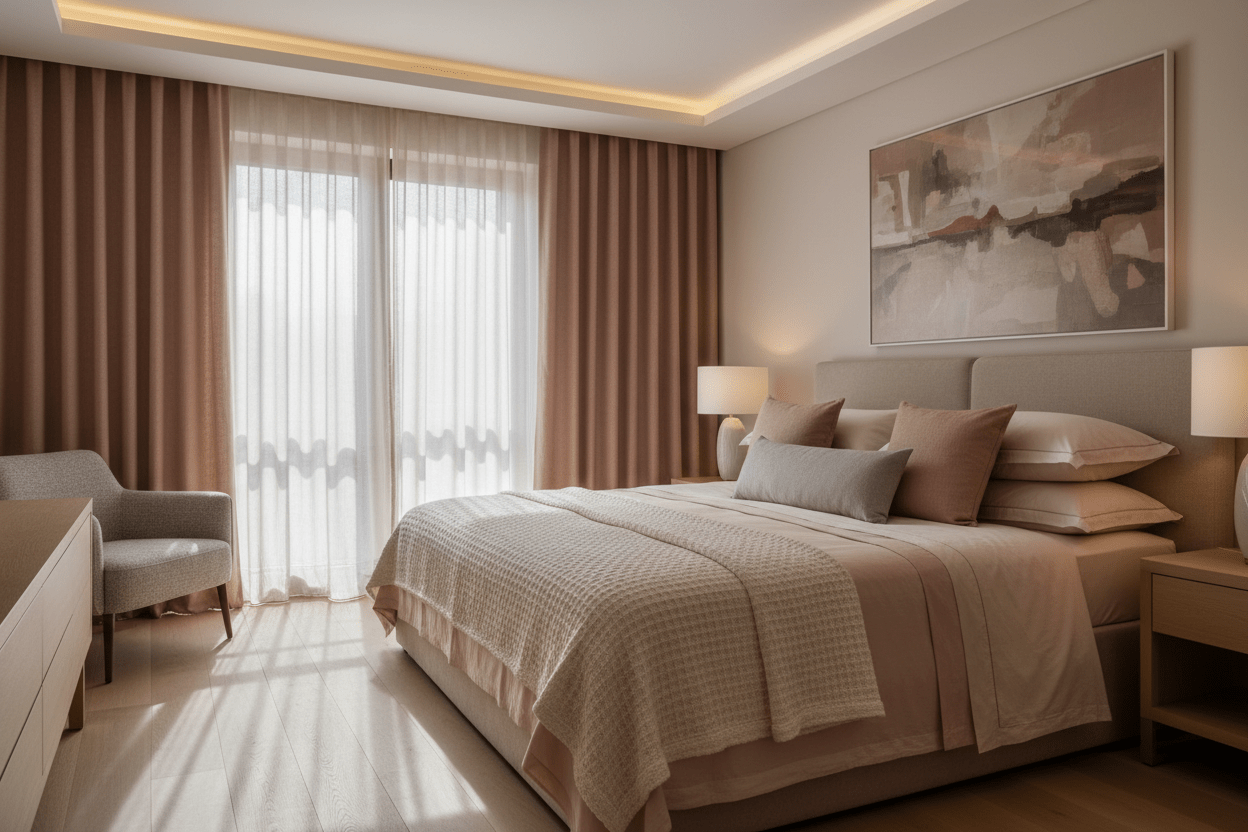
Quick Answer: To coordinate curtains and bedsheets, pick one dominant colour (usually the bedsheet or wall) and match the curtain to it in the same tone or one step darker. Use three colours maximum across the entire room — wall, bedsheet, and curtain. When fabrics differ (cotton sheet + jacquard curtain), keep the colour palette tight. When fabrics match, you can afford slightly more colour contrast.
The bedroom is the most personal room in the house — and the most seen at the start and end of every day. Curtains and bedsheets are its two largest textile surfaces. When they're coordinated, the room feels designed. When they clash, even expensive furniture can't save it.
This guide gives you a simple, repeatable system for pairing any curtain and bedsheet combination. Browse the full curtain collection and bedsheet collection to apply it.
Why coordination matters more in bedrooms than living rooms
Bedrooms have fewer visual elements to distract the eye — no coffee table, no artwork wall, no rug. The bedsheet and curtain dominate. In a living room, a mismatched cushion cover disappears behind a lamp. In a bedroom, a clashing bedsheet-curtain pair is impossible to miss.
The 3-tone bedroom textile system
Use exactly three tones across the whole room:
- Primary (60%): wall colour. Everything else responds to this.
- Secondary (30%): bedsheet. Should either match the wall (tonal) or anchor a neutral (cream on cream walls, grey on white walls).
- Accent (10%): curtain, cushion covers, or throw. Can be the colour pop — but only one item should pop.
The curtain can play the secondary or accent role. As secondary, it calms and coheres. As accent, it energises. Most Indian master bedrooms look best with curtain as secondary.
Colour pairings that always work
White walls + any bedsheet + curtain one shade deeper
The safest Indian bedroom formula. White walls are neutral enough to absorb any bedsheet colour. Pick curtains one shade deeper than the bedsheet — ivory sheet + beige curtain, blue sheet + slate curtain, sage sheet + deep olive curtain. Browse premium 300 TC bedsheets for the full colour range.
Cream walls + neutral bedsheet + earthy curtain
Terracotta, rust, or olive curtains against cream walls and a white or ivory bedsheet. The warm tones amplify each other without fighting. This is the most popular Indian master bedroom palette right now.
Grey walls + white bedsheet + patterned curtain
The cleanest modern Indian palette. Grey walls + white or off-white percale bedsheets + a subtle jacquard curtain in charcoal or teal. Very hotels, very low-maintenance.
Blue walls + cream bedsheet + white sheer curtain
Deep blue accent walls with white or ivory sheers read coastal and breezy. The cream bedsheet grounds it. This palette works beautifully in sea-facing apartments and hill stations.
Fabric coordination: matching feels vs matching colours
Colour coordination is obvious. Fabric feel is subtler but equally important:
- Cotton bedsheet + cotton curtain: perfectly cohesive. Casual, warm, everyday.
- Cotton bedsheet + jacquard curtain: intentional contrast. The bedsheet recedes; the curtain leads. Smart formal look.
- Satin bedsheet + velvet curtain: full luxury. Keep both in the same tone or the room feels overdressed.
- Linen bedsheet + linen-texture curtain: the cleanest modern look. Slightly informal.
- Cotton bedsheet + blackout polyester curtain: common for AC bedrooms. Fine — but keep the curtain matte, not shiny.
What the curtain header adds
Eyelet curtains give clean, regular pleats. Rod pocket gives a softer gathered look. For bedrooms, both work — but eyelet reads more modern and easier to draw daily. Rod pocket suits rooms where curtains stay partially drawn. Browse blackout curtains in eyelet for the standard Indian bedroom blackout setup.
The bedsheet + curtain + cushion trilogy
Once curtain and bedsheet are coordinated, add 2–3 cushion covers in the accent tone. If the bedsheet is cream and curtains are sage, use a terracotta or mustard cushion. This closes the visual triangle and makes the room feel styled.
Five coordination mistakes to avoid
- Matching exact prints: same floral on bedsheet and curtain looks like a children's craft project.
- Too many patterns: one patterned item maximum per bedroom. Others should be solid or textured.
- Too many colours: more than three tones in one bedroom always feels busy.
- Mismatched warmth: cool-toned bedsheet (blue) + warm-toned curtain (terracotta) reads unsettled unless both are neutrals.
- Short curtains: curtains that don't reach the floor undo any coordination effort. Floor-length is non-negotiable in master bedrooms.
Frequently Asked Questions (FAQs)
Q. Should curtains match bedsheets exactly?
A. No — exact match looks flat. Same tone but different shade (one step darker for curtains) looks designed.
Q. Can I use a patterned bedsheet with solid curtains?
A. Yes — this is the cleanest combination. Let the bedsheet carry the print; curtains provide the grounding.
Q. What curtain colour works with white bedsheets?
A. Almost any — white is the most versatile bedsheet colour. Sage, slate, blush, terracotta, navy all work.
Q. Is it okay if curtains and bedsheets are completely different colours?
A. Yes, if they share the same warmth temperature (both warm-toned or both cool-toned) and the wall ties them together.
Q. Should bedroom curtains be light or dark?
A. Light curtains enlarge small bedrooms; dark curtains add drama to large ones. For sleep quality, blackout lining matters more than curtain colour.
Final Word. Pick a bedsheet first, then curtains one tone deeper. Add cushion covers in an accent. Keep three tones total. Browse the curtain collection, bedsheet collection, and cushion covers at Haus & Kinder to build your palette.
