


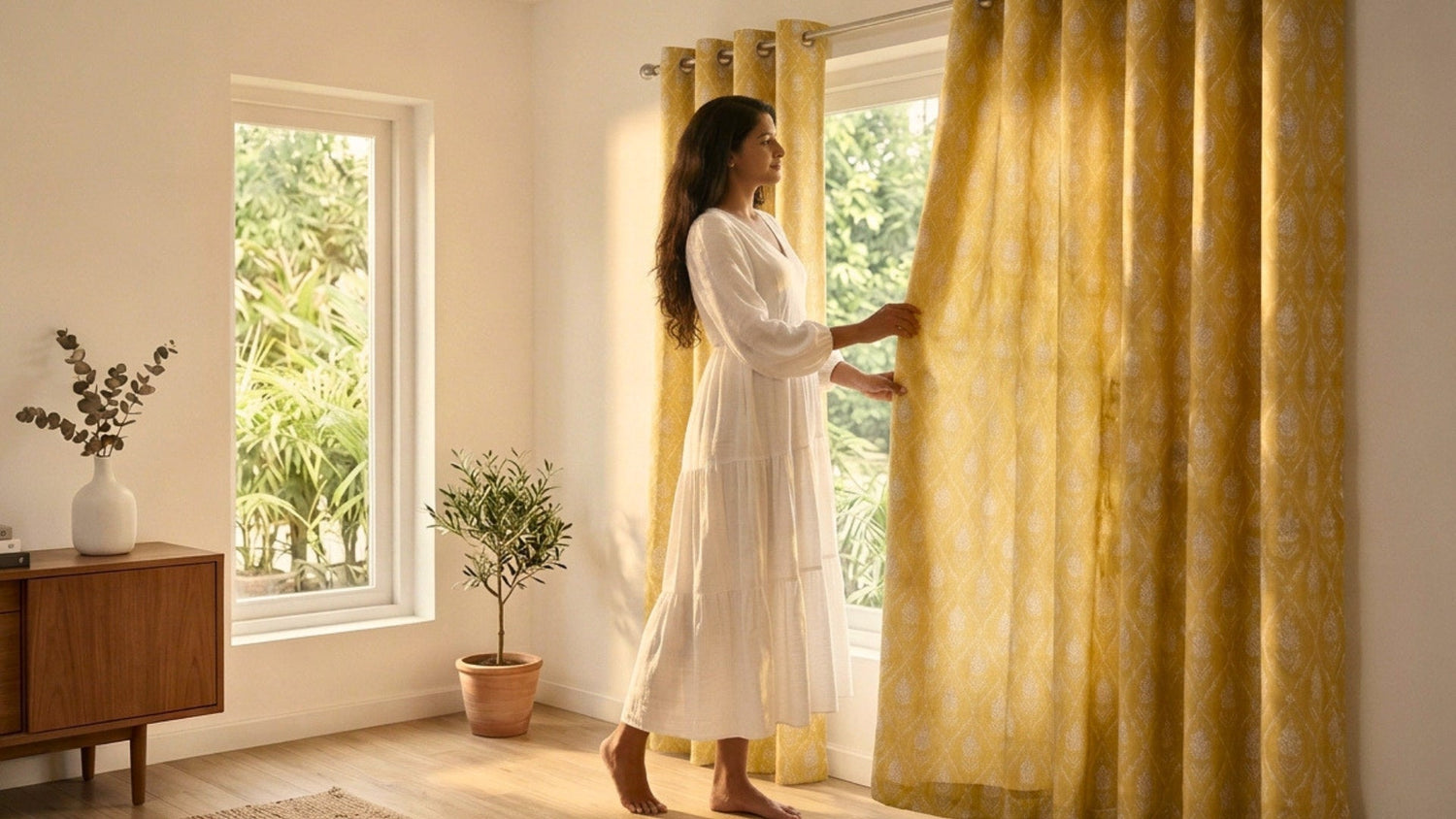
When someone steps into a house for the first time, they don't usually notice the curtains right away. Yet, remove them and the difference becomes obvious within minutes. The room feels exposed. The light feels harsher. The space feels incomplete.
This is why home curtains are more important than most homeowners realise. They are the quiet influence that makes a room function throughout the day. They affect privacy, light, temperature and even mood. In Indian homes, where the sun could be strong and buildings often close to each other, curtains are not optional accessories. They are things that we need every day.
How Curtains at Home Enhance Privacy and Security
Privacy begins with control. When windows are not covered, the interior of the home is displayed for everyone passing by. This can be uncomfortable, particularly in apartments with other buildings or busy streets facing.
Well fitted window curtains enable the space residents to decide when to open their space and when to protect it. In the evening when lights are switched on inside, the curtains make it impossible to see outside clearly. This small adjustment helps to bring back a sense of personal security.
Curtains are also a psychological boundary. When drawn, they indicate that the space within is private and protected. This simple layer of fabric often offers more comfort than one would expect.
How Home Curtains Help to Control Light and Temperature
Managing Natural Light
Sunlight fluctuates throughout the day. Morning light can have a softness and freshness to it. Afternoon glare can be overwhelming especially during summer months. Curtains let homeowners make changes in response to these changes without making structural changes to the room.
Sheer fabrics take away brightness with openness. Heavier ones block strong rays that can cause discomfort or fade furniture over time. A carefully chosen curtain for the living room helps to provide a balance between brightness and relaxation.
Light control is also a factor in productivity. Reduced glare is better for television viewing and makes work on the screen more comfortable. Curtains, therefore, affect both leisure and daily activities.
Keeping Rooms Cool or Warm
Windows are natural points of heat transfer. During the summer, sunlight coming through glass raises the indoor temperature. In the colder months, uncovered windows let the warmth escape.
Curtains are used as a protective layer. Thicker materials form insulation by trapping air between the fabric and the window. This slows down the heat exchange and allows the indoor conditions to be more stable. Over the course of time, such control may lead to less dependence on cooling systems.
Improving the Interior Style with Home Decor Curtains
Curtains as an Important Design Element
Interior spaces depend on proportion and texture for their completeness. Curtains frame windows and doors, which are often the most visible structural elements in a room. Without them, walls may look incomplete.
The selection of curtains for the home is what influences visual scale. Floor length designs create elegance. Light shades make small spaces open up. Deeper tones give warmth and richness.
Patterns introduce character without altering furniture. Textures smooth sharp lines in architecture. A carefully selected curtain for the living room can unite sofas, cushions and wall colours into a cohesive visual theme. Curtains therefore serve as design anchors as opposed to decorative afterthoughts.
Different Types of Home Curtains for Each Space
Curtains for Living Rooms
Living rooms are the social spaces. They require flexibility. Layered curtains give homeowners the option to change light according to the time of the day or the occasion. During gatherings, the brightness of nature may be welcomed. In quieter moments, less light promotes comfort.
Curtains for Bedrooms
Bedrooms are for rest and privacy. Thicker fabrics help to reduce early morning brightness and promote uninterrupted sleep. Soft textures also help to create a more calming atmosphere.
Door Curtains for Entrances, Room Separation
In many houses, door curtains are functional and decorative. They create separation between spaces without creating permanent partitions. At entrances they help to reduce the dust and the excessive sunlight from coming in directly.
Window Curtain for Ventilation and Balance of Light
Properly designed window curtains provide for air circulation without losing coverage. Panels can be adjusted to allow airflow without completely exposing interiors. This balance comes in handy especially during times of seasonal transition.
Home Curtains Enhance Comfort, Cut the Noise
Urban living tends to come with constant background noise. Traffic movement, construction nearby and neighbourhood activity can disturb the peace inside the house. Thick curtains absorb some of this sound and make echo in rooms softer.
Although they do not block out noise entirely, they do make sharpness and intensity less. The presence of fabric is what brings warmth into the acoustic environment. This is a subtle difference, but one that makes a noticeable difference over time.
Comfort is not only measured in terms of temperature. It includes emotional ease. When windows and doors are carefully framed in, rooms feel secure and complete.
Easy Maintenance and Long Term Value
Curtains need care, but are easy to maintain. Periodic washing or dry cleaning will keep fabrics fresh and keep dust away. The modern materials are engineered to maintain colour and strength if handled correctly.
Quality curtains will provide durability. While less expensive options may lose shape or fade soon, well crafted fabrics will retain structure for years. Their contribution to privacy, insulation and style goes on long after installation.
Conclusion
Curtains silently make a difference in the daily lives in every home. They control light, privacy, temperature stability, noise and improve the design harmony. Their role is much more than decoration.
For homeowners who are looking for refined designs with a focus on blending comfort and modern aesthetics, Haus & Kinder has collections designed with a thought for modern Indian spaces. With their curated range, each room is protected, elegant, and complete.
FAQs
How often should curtains at home be washed or cleaned?
Curtains should be cleaned, in general, every three to six months. Homes which are exposed to higher levels of dust may need to be washed more often to maintain hygiene and fabric condition.
Do Pricey Curtains Make a Difference?
Higher quality curtains tend to be made with better fabrics and stronger stitching. This improves durability, improves insulation performance, and ensures a more refined appearance as time goes on.
Can curtains help to reduce outside noise?
Thicker or layered curtains will absorb some of the external noise and smooth out the echoes in a room. They do not offer complete soundproofing, but they do reduce the level of disturbance quite noticeably.
Should curtains touch the floor or stop above the floor?
Floor length curtains make the room look polished and elegant. Slightly shorter lengths may be practical in areas of high traffic where cleaning and maintenance is more frequent.
