


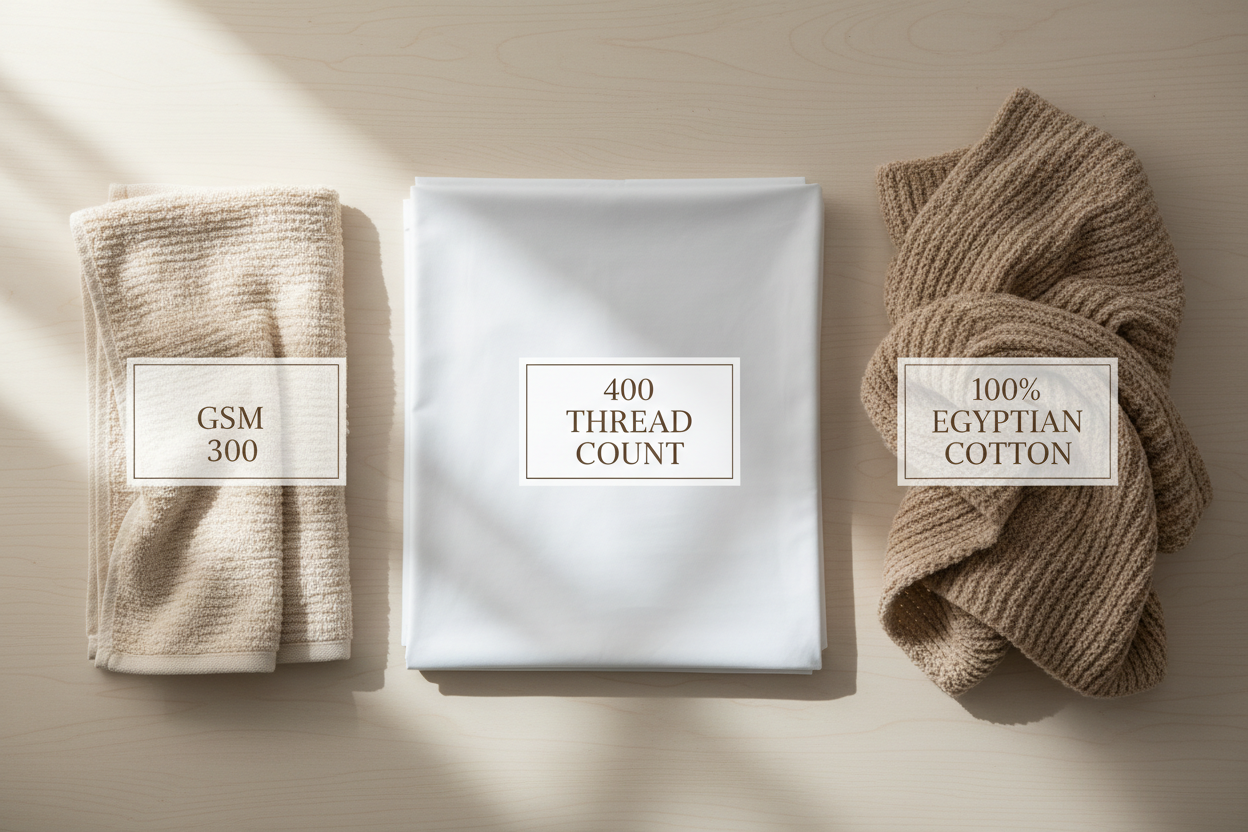
Quick Answer: On any home textile label, the three specs that actually matter are: fibre type (100% cotton beats every blend), GSM for curtains and towels (130–160 for curtains; 450–600 for towels), and thread count for bedsheets (200–300 TC is the honest sweet spot). Ignore claims above 400 TC — they use multi-ply counting tricks. Look for "combed" or "long-staple" cotton for quality bedsheets, and "pre-shrunk" or "sanforized" for size stability.
Indian home textile labels can be intimidating or misleading. "1000 TC!" "300% Egyptian!" "Ultra-luxury GSM!" Most of these claims are either meaningless or actively deceptive. Knowing how to read a label takes 5 minutes to learn and saves you from buying the wrong product for the next 5 years.
This guide decodes every common label term — what it means, what's a good number, and what's a marketing trick.
Thread Count (TC): what it means and when to trust it
Thread count is the number of threads woven into one square inch of fabric — horizontal (weft) + vertical (warp) threads combined. A 200 TC sheet has 200 threads per square inch; a 300 TC has 300.
The honest TC range
- 180–200 TC: entry quality. Light, somewhat breathable.
- 200–300 TC: the honest quality range for Indian use. Good feel, long-lasting. The Premium 300 TC range and Percale 300TC sit here.
- 300–400 TC: premium single-ply. Denser, silkier.
- Above 400 TC: almost always multi-ply counting. Two or three threads twisted together, each counted separately. A "1000 TC" sheet is usually 250 TC fabric counted 4x. Not actually 4x denser or better.
Bottom line: trust 200–400 TC claims. Be sceptical above 400 TC.
GSM: the spec that matters for curtains and towels
GSM (grams per square metre) measures fabric density — how much cotton fibre is in each square metre. Higher GSM = heavier, denser, more material. Lower GSM = lighter, more breathable.
GSM ranges by product
- Curtains: 90–130 GSM (light, sheer, summer); 130–180 GSM (medium, standard living room); 180–250 GSM (heavy, formal, winter).
- Bedsheets: 110–160 GSM is standard for 200–300 TC cotton. GSM confirms the label's TC claim is genuine.
- Towels: 400–500 GSM (quick-drying, light); 500–650 GSM (plush, standard); 700+ GSM (very heavy, slow-drying — avoid for Indian bathrooms).
If a product page doesn't list GSM, that's a red flag. Reputable brands like Haus & Kinder list both TC and GSM on every bedsheet product page and towel listing.
Cotton types: the single most important spec
Regular (carded) cotton
Basic cleaning removes dirt but leaves both long and short fibres. Standard quality. Slightly rougher feel, more pilling over time. Most budget bedsheets.
Combed cotton
An extra manufacturing step removes all short fibres with a fine-toothed comb. Result: longer, stronger, smoother threads. Less pilling, softer feel, longer lifespan. All Haus & Kinder premium bedsheets use combed cotton.
Long-staple cotton
Cotton variety naturally produces longer fibres (staples). Indian varieties include Suvin, Shankar-6; imported varieties include Egyptian and Pima. Long-staple fibres weave into stronger, smoother threads than short-staple regardless of combing.
Egyptian cotton
A marketing term as often as a genuine certification. Real Egyptian cotton uses Giza 45 or 88 long-staple varieties. Many products labelled "Egyptian cotton" use only a small percentage. Look for "100% Egyptian" and third-party verification, not just the label.
Organic cotton
Grown without synthetic pesticides or GMOs. Certified GOTS (Global Organic Textile Standard) is the credible label. GOTS-certified organic cotton is genuinely better for skin-sensitive users and environmentally preferable.
Weave types and what they mean
- Percale: plain weave (one-over-one-under). Crisp, matte, cool, breathable. The hotel-sheet standard. Best for hot Indian summers. Browse the percale collection.
- Sateen: one-under-three-over weave. Glossy, smooth, silky. Slightly warmer than percale. Better for AC bedrooms. Browse the Feather Touch 300TC.
- Jacquard: woven-in pattern (not printed). More durable pattern, textured surface. The jacquard collection for curtains.
- Terry: looped pile weave. Used for towels. The loops create absorbency. The towel range is terry.
- Muslin: loose plain weave. Very light, very breathable. Best for baby bedding and summer layering.
Key certifications to look for
- OEKO-TEX Standard 100: tests fabric for 100+ harmful substances. The most relevant standard for skin-contact home textiles, especially baby products.
- GOTS (Global Organic Textile Standard): certifies organic cotton end-to-end from farm to finished product.
- Pre-shrunk / Sanforized: not a certification, but important — indicates the fabric has been mechanically pre-shrunk so it won't distort after first wash.
Red flags on a textile label
- Thread count above 600 without specifying "single-ply".
- "Cotton rich" (can be as low as 50% cotton).
- No GSM listed (hides thin fabric).
- No wash care instructions.
- Strong chemical smell out of packaging (residual dye or finish).
- "1000 TC luxury hotel quality" at under ₹500 (physically impossible).
The quick label test
Before buying any bedsheet or curtain, look for these four things on the label:
- 100% cotton (not "cotton rich" or "poly-cotton").
- GSM stated (110–160 for bedsheets; 90–180 for curtains).
- "Combed" or "long-staple" cotton mentioned.
- "Pre-shrunk" or "sanforized" on the label.
Any product passing all four is worth buying. Products missing all four — skip.
Frequently Asked Questions (FAQs)
Q. Is 300 TC really better than 200 TC?
A. For softness and feel — yes. For breathability in Indian summers — 200 TC percale can actually feel cooler.
Q. How do I know if Egyptian cotton is genuine?
A. Look for third-party certification (CCI — Cotton Egypt Association). Most "Egyptian cotton" claims in India are unverified.
Q. What's the difference between GSM and TC?
A. TC counts threads per square inch (density). GSM measures grams per square metre (weight). Both together give a complete picture of fabric quality.
Q. Is combed cotton worth paying more for?
A. Yes, for daily-use bedrooms. Combed cotton bedsheets last 1–2 years longer and feel noticeably smoother.
Q. What does "sanforized" mean?
A. Industrial pre-shrinking. A sanforized bedsheet won't shrink more than 1% after washing — crucial for fitted sheets staying on mattresses.
Final Word. 100% combed cotton, 200–400 TC, stated GSM, pre-shrunk. That's the label checklist. Every Haus & Kinder product — from bedsheets to curtains to towels — has full specs listed so you never have to guess.
